

We often hear that most older adults prefer to remain in their homes as they age. But what drives that preference? A recent study by the AP-NORC Center for Public Affairs Research highlights common reasons people want to age at home and points to broader issues underlying those preferences.
Research on long-term care preferences
The AP-NORC analysis draws on responses from a NORC panel designed to represent U.S. households age 18 and older. The report, “Long-Term Care in America: Americans Want to Age At Home,” released in May 2021, uses panel responses to long-term care questions collected in March–April 2018 (1,945 respondents), August–September 2020 (1,893 respondents), and March 2021 (1,113 respondents).
Those responses reveal Americans’ views on where and how they would like to receive care as they grow older.
Key findings about care and aging at home
Receiving care at home
Overall, 88% of Americans prefer to receive ongoing assistance or care in their own home or the home of a loved one. Only 12% would choose care in a senior living community, such as assisted living or a nursing home.
This strong preference is not solely a reaction to the COVID-19 pandemic; it has been steady for several years. In 2020, 89% preferred home-based care, and in 2016, 81% reported the same preference.
Support for government action on long-term care costs
Many Americans expect institutions to shoulder much of the financial burden for long-term care. Respondents indicated that health insurance companies (52%), Medicare (51%), and Medicaid (41%) should cover long-term care costs. In contrast, 35% think individuals should pay, and just 15% believe the recipient’s family should be responsible.
Majorities also support government involvement: 60% favor a government-administered long-term care insurance program similar to Medicare, and 63% back government funding for programs like Medicaid to help low-income individuals receive care at home.
Despite that support, nearly half of respondents (49%) expect Medicare to pay for long-term care services as they age. In reality, Medicare covers long-term care only in limited situations and for a limited time, which points to a gap between public expectation and program coverage.
Few discussions or preparation for aging at home and long-term care
Although it’s important to communicate care preferences, few people have discussed long-term care plans with their doctors (11%) or family and friends (31%). Even among those aged 60 and older, only 14% spoke with doctors and 46% with family and friends about their preferences.
Many also feel unprepared: 69% have done little or no planning to make aging at home feasible, and just 16% are confident they will have sufficient financial resources for long-term care, whether at home or in a senior living community.
>> Related: New Statistics Could Reshape the Meaning of Aging in Place
A variety of concerns about aging and care settings
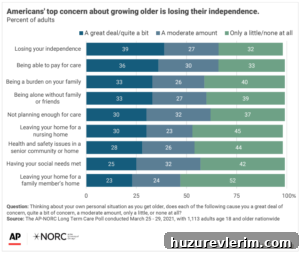
Image credit: AP-NORC
Concerns about isolation, unmet social needs, and loss of independence were common themes in the AP-NORC findings. Sixty percent of respondents worried about becoming isolated from family or friends as they age, and 57% feared their social needs would go unmet. More than half (53%) were concerned about having to move into a nursing home.
The top worry was losing independence: 67% said they were moderately to greatly concerned about that prospect. Closely related, 53% worried about leaving their home to move into a nursing facility.
>> Related: What’s the True Cost of Staying in the Home?
Addressing the top concerns about senior living and care
The AP-NORC results and the concerns they reveal point to the need for action from both policymakers and the senior living industry.
Systemic solutions
Policy solutions should focus on enabling people who want to age at home to remain independent as long as possible. Supporting elders requires community-based approaches—transportation, social programs, and accessible care services that combine technology with human support. Innovations like virtual health visits, assistive technologies, and other tools can help, but they must be integrated with in-person services that address social and practical needs.
Solutions from the senior living industry
The senior living sector must respond to the fears identified in the poll. Communities should better communicate how their design, services, and amenities can help residents remain independent longer. Emphasizing aging-friendly architecture, on-site supports, and social opportunities can counter concerns about isolation and loss of autonomy.
Communities should also aim to preserve residents’ autonomy while ensuring safety—using technology thoughtfully and maintaining strong in-person engagement. Affordability is another major worry; senior living providers can help by offering clear consumer education and financial planning tools so prospective residents understand options and costs.
Not everyone will choose or be able to move into a retirement community, but transparent information and practical tools can make options easier to evaluate. Senior living communities can highlight the advantages they offer: more social opportunities, reduced isolation, less risk of becoming a burden to family, and built-in safety measures.
>> Related: “…but I love my home”: Is Staying in Your House the Right Move?
Empowering older adults to live and receive care where they prefer
Decisions about where to live as you age are deeply personal and depend on many factors. For some, aging at home is the clear preference regardless of logistical or financial challenges. For others, it may feel like the only option due to cost, a partner’s needs, or the difficulty of downsizing and moving.
The AP-NORC study underscores a strong preference for aging in place but also highlights the need for policymakers to support choices with practical solutions—especially to expand home-based care that meets health, safety, and social needs. As the population ages, senior living providers should refine messaging to address prospects’ worries about independence and affordability and to showcase the tangible benefits of community-based living.