

What if you could live in a retirement community that offers services, amenities, and an atmosphere on par with the world’s finest hotels? For many affluent older adults, that vision of luxury senior living is becoming a reality.
There is rightly substantial attention on making senior living more affordable for average, middle-income retirees. At the same time, research shows a growing market for higher-end, luxury senior living as a rising share of retirees enter higher income brackets. The industry is responding with an expanding variety of communities designed for affluent prospective residents.
More retirees, more prospects for retirement communities
Over recent decades, the market for senior living communities—particularly assisted living and independent living—has evolved significantly, largely driven by the Baby Boomer generation. According to U.S. Census data, roughly 10,000 Baby Boomers reach retirement age every day. By 2030, all Baby Boomers will be at least 65, and many are choosing to move into 55-plus communities.
As in any market, supply and demand matter in senior living. Investors and operators must evaluate local and national market dynamics and make strategic decisions about product type, pricing, and amenities.
Long-term studies, such as those sponsored by the National Institute on Aging, provide valuable insight into the characteristics and financial capacity of today’s retirees and those soon to retire, helping providers anticipate future demand and budgets for senior living.
>> Related: Are Today’s Seniors “Younger” Than Previous Generations?
A growing number of wealthy retirees
The Health and Retirement Study (HRS), a longitudinal survey of about 20,000 Americans aged 50 and older conducted by the University of Michigan since 1994, tracks economic, health, marital, and family characteristics across cohorts. Its findings indicate that as Baby Boomers retire, the percentage of older adults in higher income brackets is steadily increasing. Analysis of HRS data shows the number of retirees aged 75 and older in high-income brackets is expected to roughly triple from 2014 to 2029.
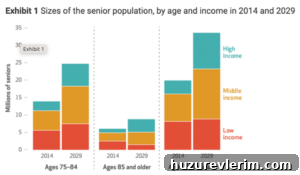
Image source: “The Forgotten Middle: Many Middle-Income Seniors Will Have Insufficient Resources For Housing And Health Care”; based on the study authors’ analysis of data from the Health and Retirement Study
This increase in retiree prosperity stems from factors such as effective 401(k) investing, pensions, and a larger share of retirees with college educations who earned higher wages during their careers.
The upward financial trend among retirees fuels demand for luxury senior living: white-glove concierge services, expansive spa facilities, curated cultural programming, and elevated dining experiences. Monthly fees at some high-end communities can exceed $10,000.
>> Related: The Cost of a CCRC vs. the Value to Residents
Redefining the luxury senior living “vibe”
The luxury senior living sector is also shifting in what it defines as true luxury. A 2023 piece in Senior Housing News emphasizes the difference between “excellence” and “luxury.” Lisa Swafford, vice president of strategy and business development at Galerie Living, describes luxury as a feeling—how residents are treated and how staff interact with them.
True luxury emphasizes personalization and creating memorable moments. To cultivate that “vibe,” some luxury operators draw on training and best practices from top hospitality and culinary institutions, ensuring staff across all roles deliver thoughtful, individualized service.
Training examples highlight the difference: a plate of fruit that is simply arranged represents excellence; arranging the same fruit into a handcrafted flower elevates the experience to luxury. Those details—presentation, attentiveness, and personalization—shape residents’ daily lives.
>> Related: Senior Living Communities Keep Upping Their Food and Dining Game
Luxury senior living communities offer a distinctive lifestyle
Luxury extends far beyond fine dining. Residents expect to feel pampered across all aspects of community life, so many operators train every team member—from housekeeping to caregivers and event planners—to provide elevated, personalized service.
Programming in some luxury communities includes bespoke classes, such as beekeeping or craft brewing, and curated experiences like gourmet wine dinners led by celebrated chefs and sommeliers. On-site cultural offerings might include gallery exhibitions or artist-in-residence programs.
Architectural design and finishes also reflect residents’ expectations. Many affluent retirees move from sophisticated homes and have experienced global travel, so communities invest in elegant design, high-end materials, and thoughtfully curated interiors that may evoke Parisian streetscapes or upscale urban residences.
>> Related: CCRC Services and Amenities Include Many Attractive Perks
Senior living options needed for the less affluent
While demand for luxury senior living grows, two important points must be emphasized.
First, there cannot be a single vision for the future of senior living. Older adults have diverse needs, finances, and preferences, so the industry must offer a range of options at different price points and continue innovating to help people age in place if they prefer.
Second, only about one-third of those aged 75 and older are high-income. Most are middle-income, with a substantial and growing share in that category, and roughly a quarter are low-income. A 2019 study, “The Forgotten Middle: Many Middle-Income Seniors Will Have Insufficient Resources For Housing And Health Care,” highlighted how the industry has focused on the upper end while public programs serve lower-income individuals. Middle-income seniors often fall between these two systems: ineligible for means-tested programs yet unable to afford sustained private-pay senior housing. Medicare does not cover seniors housing or long-term care services.
It is essential that the industry’s expansion into luxury options does not come at the expense of creating solutions for middle- and low-income retirees. A balanced approach—one that includes affordable, flexible, and innovative housing and care options alongside luxury offerings—will best serve the diverse needs of an aging population.
>> Related: Senior Living and Care Industry Must Create Solutions for Middle-Income Seniors