

The U.S. Small Business Administration (SBA) advises small businesses with revenues under $5 million to allocate about 7–8 percent of total revenue to marketing. In its 2021 annual survey of chief marketing officers, Deloitte reported that marketing budgets averaged roughly 11.7 percent of companies’ overall budgets — near a record high.
That same survey found industry variation: B2B product companies spend about 10 percent of revenue on marketing, similar to B2C services at 10.1 percent. B2B services and B2C products invest more heavily, allocating roughly 15 percent and 18 percent of revenue respectively. Healthcare organizations typically spend around 7 percent of revenue on marketing.
Where does senior living — especially continuing care retirement communities (CCRCs), also known as life plan communities — fit into these ranges? And how should CCRCs allocate their marketing dollars to reach the right prospects effectively?
>> Related: For Senior Living Decisions, Are You a Planner, Procrastinator, or Crasher?
Marketing to today’s consumer
Advertising and marketing channels have shifted dramatically over recent decades, moving from print and radio to television and, increasingly, digital platforms. Modern marketing best practices recommend diversifying spend across multiple channels to reach audiences where they are. Common channels include:
- TV and radio spots
- Print advertisements (newspapers, magazines)
- Direct mail campaigns
- Billboards
- Email marketing
- Paid ads on social media and search engines
- Organic social media content
How much of your budget goes to each depends on target demographics and market research. For the senior living sector, a key trend to recognize is that more seniors are using the internet, social media, and streaming services — so adjusting the mix to favor digital can improve reach and ROI.
>> Related: Are Today’s Seniors “Younger” Than Previous Generations?
Seniors have bridged the digital divide
A 2021 Pew Research survey illustrates how quickly older adults have adopted technology. Highlights include:
- 75 percent of adults 65 and older report using the internet; 96 percent of those aged 50–64 use the internet.
- Smartphone ownership among adults 65+ rose to 61 percent in 2021, up from 13 percent in 2012; among 50–64 year-olds it reached 83 percent.
- Tablet ownership for adults 65+ climbed to 44 percent (from 6 percent in 2012); the 50–64 group rose to 53 percent.
- Social media use among adults 65+ increased to 45 percent (from 11 percent in 2012); for those 50–64 it grew to 73 percent. YouTube and Facebook are the most popular platforms for these age groups.
Given these changes, CCRCs should consider reducing some print spend in favor of targeted digital marketing to capture the attention of increasingly connected seniors.
>> Related: Marketing CCRCs to the Next Generation of Retirees
Marketing your CCRC to the tech-savvy senior with MoneyGaugeTM
The primary goal of online marketing is usually to drive qualified traffic to your website, where potential residents can explore community features and services. A senior-focused website should offer engaging photography and graphics, clear navigation, accessible content, and helpful educational resources. Strong calls to action guide visitors into the next step of the inquiry process.
One common concern for prospective residents is affordability. To address this, communities can provide tools that help visitors understand how their personal finances relate to senior living costs. Embedding an affordability tool directly on your site can demystify pricing and encourage qualified leads to reach out.
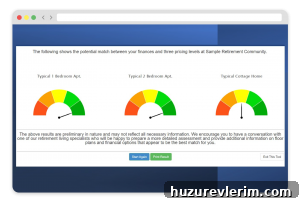
MoneyGauge, customizable to a community’s specifications, offers visitors a preliminary assessment of lifetime affordability for CCRCs and other senior living models (rental, hybrid, 55+, etc.). Functioning as a pre-qualification tool, it captures essential financial information securely for your team’s follow-up. This helps save time for prospects and sales staff while identifying seniors who are a strong financial fit for the community.
Beyond helping visitors evaluate affordability, MoneyGauge is an effective way to capture contact information for the most promising prospects, strengthening your sales pipeline.
>> We invite you to learn more about how MoneyGauge can benefit your prospects and your sales pipeline by scheduling a free demo today!