
Retirees considering a move to a continuing care retirement community (CCRC), also known as a life plan community, often find the variety of contract types confusing. Many communities offer multiple contract options, and one newer variation gaining attention is a lifecare contract with equalized pricing. This option may be attractive to some prospective residents.
A concise overview of the traditional types of CCRC contracts
The descriptions below assume other factors are comparable, such as unit size, services, amenities and location.
Lifecare (Type A): This contract effectively pre-pays for a portion of future health-related services. It usually carries the highest monthly fee for residents in independent living and may also require a larger entry fee. The main benefit is stable and predictable costs for care if it becomes necessary.
Modified (Type B): Modified contracts typically have a lower monthly fee and often a lower entry fee than lifecare agreements. They generally include the same residential services and amenities, but if assisted living or skilled nursing is needed, residents are responsible for some or all additional costs.
Fee-for-Service (Type C): Fee-for-service contracts usually have the lowest monthly and entry fees. Residential services and amenities are provided, but when assisted living or skilled nursing care is required, the resident pays the market rate for those services, leading to higher monthly costs at that point.
Rental: Rental arrangements commonly require no entry fee or only a small community fee and are often month-to-month. Because no large up-front payment is required, monthly service fees tend to be higher than in communities that charge an entry fee. Rental contracts may offer priority access to healthcare facilities, but that access is not always guaranteed. Healthcare services in rental communities are typically provided on a fee-for-service basis.
A twist on lifecare: equalized pricing
One of the main advantages of a traditional lifecare contract is that it generally keeps most residential services, amenities and health-related care available with little or no increase in monthly charges—making long-term expenses more predictable despite changing care needs.
Increasingly, CCRCs are offering a variation called equalized pricing. It preserves the core benefit of a lifecare contract—predictable lifetime expenses—but changes how monthly charges are set when a resident makes a permanent move to assisted living or skilled nursing. Instead of continuing to pay the same monthly amount they paid in independent living, residents transition to a rate that is typically set at the community’s median cost for independent living residences.
Put simply, equalized pricing can mean a resident from a lower-priced unit may pay more for care after moving, while a resident from a higher-priced unit may pay less. The approach spreads care costs more evenly among residents by aligning post-transfer fees with a central benchmark rather than each individual’s original independent-living rate.
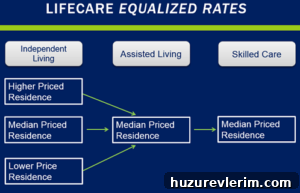
For couples, equalized pricing may apply separately to each spouse as they transition from independent living to higher levels of care, which can affect long-term financial planning—especially if one or both chose lower-cost independent living accommodations. When comparing CCRC contracts, prospective residents should review how equalized pricing is defined in the contract, how the median or benchmark rate is calculated, and whether there are caps, protections or guaranteed limits on future increases to ensure the arrangement meets their financial and care expectations.