

For older adults considering a move to a continuing care retirement community (CCRC), also called a life plan community, the variety of contract options can be confusing. Many CCRCs offer several contract types, each with different financial structures and implications for long‑term care costs.
One notable development is a variation of the traditional Lifecare (Type A) contract known as equalized rate pricing. This approach aims to provide greater transparency and fairness and may appeal to financially savvy senior living prospects. In recent years some CCRC providers have begun offering equalized rate pricing as an alternative to the traditional “true” lifecare model.
A quick overview of traditional CCRC contract types
To simplify comparisons, assume factors such as residence size, amenities, and location are equal. Here are the four main CCRC contract types:
Lifecare (Type A) contract
The Lifecare or Type A contract is the most comprehensive and typically has the highest initial cost. It often includes a larger entrance fee and/or higher monthly fees while the resident lives in independent living, but it provides access to assisted living, memory care, or skilled nursing with little or no increase in monthly costs. Over time, if extensive care is required, a Type A contract can be less expensive and offers predictable long‑term costs.
Why people choose it: Predictability. Type A contracts usually allocate part of fees to a healthcare reserve that helps offset future care expenses, reducing the risk of unexpectedly large increases in cost when care is needed.
Modified (Type B) contract
Modified or Type B contracts are a middle‑ground option. They typically have lower entrance and monthly fees than Type A and include a set number of days of care at no extra cost or care provided at a discounted rate.
Why people choose it: Type B contracts are more affordable up front while still offering some protection against future care costs.
Fee‑for‑Service (Type C) contract
Fee‑for‑Service or Type C contracts are generally less expensive initially but can become costly if care is needed. They usually feature the lowest entrance and monthly fees, with healthcare services billed at prevailing market rates when required.
Why people choose it: Lower upfront costs and flexibility. Residents only pay for care if and when they need it, but should expect possible higher costs later.
Rental CCRC contract
Rental contracts are often month‑to‑month arrangements with little or no entrance fee (sometimes a modest application or community fee), higher monthly service fees, and a fee‑for‑service care model. They typically do not guarantee long‑term care availability or price locks.
Why people choose it: Flexibility and a low barrier to entry, which can be appealing to those unsure about long‑term plans or unable to pay a large entrance fee.
A twist on the lifecare contract: Equalized pricing
The Type A lifecare contract attracts many prospects because it provides financial predictability for future healthcare expenses. However, some residents view the traditional model as unfair: residents from smaller, less expensive independent living units continue paying their lower independent living rate even after moving into higher‑cost care settings, while residents from larger, pricier units continue to be charged their higher rate after they no longer occupy those larger residences.
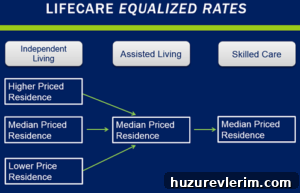
To address this concern, some CCRCs have adopted equalized pricing within their Type A contracts. Typically, equalized pricing works like this:
- When a resident permanently moves to assisted living or skilled nursing, their monthly fee is adjusted to the median monthly cost of all independent living residences in the community.
- This means residents from smaller, lower‑cost units may see a moderate increase in monthly fees, while residents from larger, higher‑cost units may see their monthly fees decrease.
This method equalizes care costs across the community, encouraging fairer cost‑sharing and greater financial balance among residents.
A note on double‑occupancy couples and equalized pricing
Under equalized pricing, each resident pays the stated individual cost for care. If both partners require care, the couple moves from paying a double‑occupancy independent living rate to each paying the equalized individual care rate. Even if a couple originally occupied the community’s median‑priced unit, they may pay more as a couple because equalized rates are applied to each person when care is needed.
This differs from true lifecare where the independent living double‑occupancy rate can remain in place even if one or both people require care.
Why equalized pricing matters
With care costs rising, predictability and equitable pricing are increasingly important. National surveys show high median costs for assisted living and skilled nursing, and these figures vary widely by region. An equalized pricing lifecare contract can help residents plan for future expenses while ensuring access to needed care at a fair, community‑wide rate.
Another benefit is behavioral: equalized pricing encourages residents to choose independent living units that best fit their lifestyle needs rather than being steered by future cost implications, since care costs will be equalized across the community.
Is an equalized pricing lifecare contract right for you?
A CCRC can provide independent living with the assurance of a continuum of care if needed. When evaluating options, be sure to:
- Thoroughly understand each contract type and what is included.
- Ask whether the community offers equalized pricing or a true Type A lifecare contract, and if equalized, inquire how rates are calculated.
- Consider the impact on couples, particularly if one partner requires care while the other remains in independent living, since equalized rates may apply individually and affect overall financial planning.
No single contract fits everyone, but equalized pricing lifecare contracts offer an alternative that combines financial stability with greater fairness. As more CCRCs adopt this option, equalized pricing may become a widely accepted approach, giving residents improved confidence that future care will be accessible and equitably priced.
Originally posted May 5, 2016; updated June 17, 2025