

Continuing Care Retirement Communities (CCRCs), also known as Life Plan Communities, appeal to older adults who are currently healthy but want a residence that can provide assisted living or higher levels of care if needed later. The primary advantage is a single, long-term home: ideally, residents do not need to move again when their care needs change, which offers reassurance to both residents and their families.
Providing lifetime housing and healthcare is costly, so CCRCs must carefully price residency contracts to manage both current and future financial risk. Actuarial consultants commonly help design these contracts by estimating future costs and liabilities for the resident population, but contract details can vary significantly between communities.
The payment structure of a CCRC contract has two main components: Buy-In Structure and Monthly Payment Structure.
CCRC Buy-In Structure
The buy-in structure determines the up-front payment required to move into a CCRC. There are three common approaches:
- Entry Fee: The resident pays an up-front entry fee, which may be refundable or non-refundable depending on the community.
- Equity: The resident purchases the residential unit and can resell it later.
- Rental: No substantial up-front payment or purchase is required beyond a nominal community fee.
CCRC Monthly Payment Structure
The monthly payment structure defines how monthly fees change when a resident begins to need care services. The main types are:
- Fee-for-Service: When care is needed, the monthly fee increases to reflect the market rate for those services.
- Modified: Similar to fee-for-service, but care is discounted or a limited number of care days are included before the monthly rate increases.
- Lifecare: The monthly rate remains essentially the same whether a resident is independent or requires care. Some lifecare communities apply a pooled or averaged monthly charge when residents require care, which can cause residents from lower-priced units to see an increase and those from higher-priced units to see a decrease.
How Buy-In and Monthly Payment Structures Interact
Generally, there is a trade-off between the buy-in amount and ongoing monthly costs. Lifecare contracts often require a larger entry fee (and sometimes higher independent-living monthly fees) but reduce or eliminate extra charges for assisted living or healthcare. Conversely, fee-for-service contracts typically have lower entry fees and lower independent-living monthly payments, but the monthly cost rises when care is required.
“All other things equal” is important to note because other market factors affect pricing—location, amenities, and overall service level all influence cost. For example, a fee-for-service community with waterfront views in a major city will likely cost more than a lifecare community in a rural area, even if their contract types differ.
The combinations of buy-in and monthly-payment options create several possible contract models. Rental contracts typically operate on a fee-for-service basis, and independent-living monthly rates at rental communities can be higher than those at entry-fee communities, again depending on location and amenities.
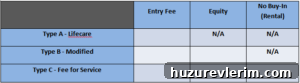
There are six main pairings of buy-in and monthly-payment structures. Understanding how each pairing shifts the balance of up-front versus ongoing costs can help prospective residents choose the model that best fits their financial situation and care expectations.
If you are evaluating a continuing care retirement community for yourself, a family member, or a client, this overview is intended to help clarify the common contract types and how they affect both up-front and long-term costs. Consider each community’s buy-in option, monthly-payment approach, location, and amenities when comparing choices, and consult the community’s financial disclosures and contract terms carefully before making a decision.