

If you are considering continuing care retirement communities (CCRCs), also known as life plan communities, you have likely encountered entry fees. These fees grant contractual access to a continuum of care services you might need in the future. Nationally, entry fees average over $200,000 but vary widely by region and by the type of contract offered. Many providers offer refundable entry fee options in addition to the traditional declining balance contract.
>> Learn more about refundable contracts here
Common refundable entry fee levels include 50%, 75%, and 90%. Refunds are typically paid to the resident if they move out, or to the resident’s estate upon death, regardless of how long the resident lived in the community. Refund conditions vary by community, so read contract details carefully before deciding.
Which entry fee refunds are best financially?
When choosing between different refundable contracts, a prospective CCRC resident may wonder which option is the better financial choice over the long term. The central question is whether it makes sense to pay a higher entry fee now to receive a sizable refund later, or to pay a lower entry fee now and keep more cash today but receive little or nothing back in the future (especially if you remain in the community past the common amortization period of 2–4 years).
There is no universal answer because providers price contracts differently, and personal preferences matter. Some people simply prefer the peace of mind of getting part of their entry fee back, regardless of the math. Others focus strictly on projected financial outcomes.
Illustrating the entry fee trade-offs
To illustrate how choices might play out, consider sample scenarios for a couple aged 78 and 79 using pricing for a lifecare contract with these entry fee options:
- Traditional, declining balance
- 75% refund
- 90% refund
All assumptions other than the contract pricing were held constant across scenarios. The chart below shows the projected ending balance of the couple’s savings and assets after 12 years (approximate life expectancy) plus any applicable entry fee refund:
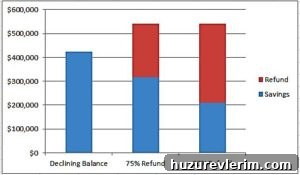
Note: “Savings” in the chart represents the total value of the couple’s savings and other assets.
In this scenario, the two refundable contracts yield almost identical totals when combining the couple’s savings with the refundable entry fee, and both exceed the total from the traditional declining balance contract. However, the 75% refund option leaves the couple with almost 50% more cash in their personal accounts after twelve years than the 90% refund option, making the 75% choice clearly preferable between those two. The declining balance contract is best solely in terms of the cash remaining in the couple’s own accounts.
Impact of higher rates of return
Next, consider the same scenarios but with the couple earning an average annual return of 6% instead of 3%. A 6% return is somewhat optimistic for a conservative 12-year horizon, but this test shows how higher returns affect outcomes:
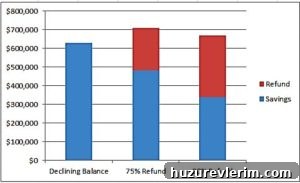
With a 6% return, the couple’s savings and assets under the traditional contract are nearly 50% higher at the end of twelve years than they were under the 3% scenario. The gap between the declining balance contract and the 75% refund option narrows by roughly half. In general, as the couple earns more on their own money, refundable contracts become less attractive because CCRCs rarely pay interest on entry fee refunds.
Impact of lower rates of return
Conversely, if the couple’s investments earn only 1% annually, refundable contracts have a larger effect on the total dollar outcome:
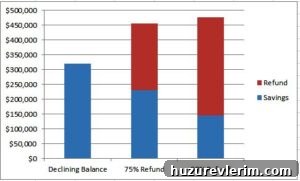
At a 1% return, refundable contracts produce much higher totals compared with the declining balance option. In this case the 90% refund yields a slightly higher total than the 75% refund, although the couple retains substantially less cash in their own accounts. The refundable totals can be nearly 50% higher than the couple’s projected personal savings under the declining balance option.
The bottom line on entry fee refunds
These examples reflect pricing from a single provider and may not represent outcomes using another provider’s figures. The key determinant in these scenarios is the growth rate of the couple’s own investments. Higher personal investment returns make the traditional declining balance contract more attractive, while lower returns make refundable contracts comparatively more valuable.
Even in the 6% return scenario, when the refundable entry fees are added to the couple’s savings, none of the test cases showed the couple doing better by choosing the lower-cost traditional contract and keeping the difference in savings. That said, refunded money is not available until it is actually paid back, which is an important practical distinction to consider.
NOTE: These scenarios use pricing for an all-inclusive lifecare community. Results could differ under a fee-for-service contract.