

As the COVID-19 pandemic entered its third year, the United States approached a devastating milestone of nearly 1 million deaths. Older adults have borne a disproportionate share of that burden. Ironically, many seniors also experienced harm from some safety measures designed to protect them, including increased isolation and disrupted routines. Despite these challenges, new research highlights an encouraging finding: many older adults showed notable resilience throughout the crisis.
The Age Well Study
Chicago-based Mather is a non-denominational nonprofit devoted to improving life for older Americans. The organization operates neighborhood programs, no-membership-required senior gathering cafés, an independent living rental community, and two continuing care retirement communities (CCRCs). To advance knowledge about aging and senior living, Mather established the nationally recognized Mather Institute, which partners with universities, healthcare organizations, and community groups to study the lives of older adults.
Beginning in 2018, Mather Institute and researchers at Northwestern University launched the longitudinal Age Well Study. This five-year project uses annual surveys to track CCRC residents’ self-reported physical, cognitive, and psychosocial health, measuring how life in a CCRC affects overall well-being. Researchers compare those results with a demographically similar group of community-dwelling older adults using data from the Health and Retirement Study conducted by the University of Michigan’s Institute for Social Research.
More than 5,700 residents from 122 CCRCs nationwide have participated in the study, which examines a different topic each year.
Enduring stress, showing resilience
The Year 4 survey, conducted between January and May 2021, focused on CCRC residents’ stress and resilience during the pandemic. Respondents were skewed toward specific demographics: 55 percent were age 85 or older, 67 percent were women, 62 percent identified as Protestant, and 98 percent were white. About half were married and roughly 39 percent were widowed. Educational attainment was high—77 percent had a bachelor’s degree or higher—and 55 percent reported household incomes of $100,000 or more. Participants lived across the country.
Researchers examined personal characteristics (such as personality and personal resources), social relationships, and coping strategies to understand how residents managed pandemic-related stress. The overall picture was positive: residents living in CCRCs showed favorable outcomes in nearly every category analyzed. Exceptions included higher stress or lower resilience among participants with neurotic personality traits and among those who relied on increased screen time, eating and snacking, or consulting a mental health provider as primary coping strategies.
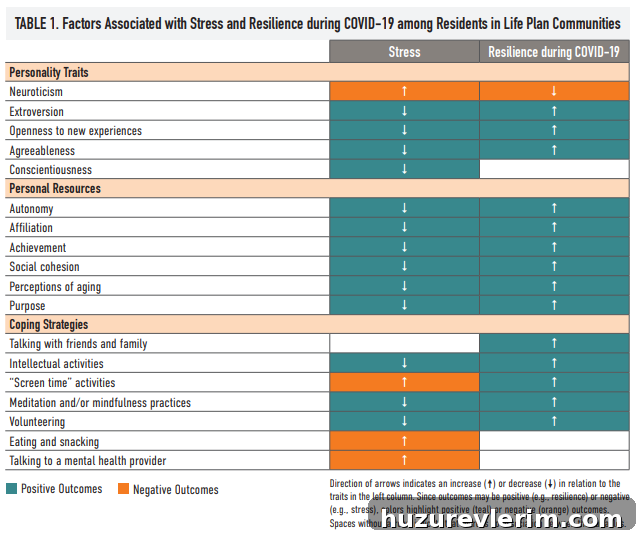
Image source: Mather Institute, The Age Well Study – Year 4 Report
The full Year 4 report offers a detailed breakdown of these findings and the measures used to assess stress and resilience.
CCRC residents continue to thrive amid adversity
Nearly everyone experienced elevated stress during the pandemic—worries about health, finances, and loved ones, along with the strain of social distancing and disrupted routines. Older adults were particularly vulnerable to both the virus and the consequences of protective measures. Yet the Age Well Study suggests that seniors in CCRCs generally fared well on measures of stress and resilience.
Supporting evidence from other research aligns with this conclusion. A 2021 survey of 64,000 senior living residents and family members found that 20 percent of residents reported severe loneliness—lower than a pre-pandemic estimate of 27 percent. This indicates that many senior living communities managed to maintain social connection and emotional support even under restrictive conditions.
Learning from seniors’ example
Older adults often face ongoing stressors—chronic health issues, losses, and major life transitions—that can challenge mental and physical well-being. Yet many maintain good health and a positive outlook, which researchers attribute to resilience: the ability to adapt, recover, and even grow in the face of adversity. For seniors living in CCRCs, the protective effects of a supportive environment, established social networks, and practiced coping skills may have helped them navigate pandemic-related challenges more effectively than expected.
The study’s findings suggest that resilience is not only common among older adults but that it can be fostered by community, resources, and adaptive strategies. Those lessons—particularly the value of social support, purposeful engagement, and flexible coping—offer practical insights younger generations can learn from their elders.