

A continuing care retirement community (CCRC), also known as a life plan community, is a senior housing option that combines independent living with access to higher levels of long-term care, such as assisted living and skilled nursing, if those services become necessary. Beyond the social and wellness benefits of life on campus, CCRCs offer residents and their families the reassurance of knowing that appropriate care will be available over time.
That continuity of housing and healthcare comes at a cost. To preserve both current operations and long-term financial stability, CCRCs must price residency contracts carefully. Actuaries and financial consultants commonly help communities estimate future costs and liabilities for their resident populations. Still, contract details vary widely among communities, so prospective residents should read the fine print before committing.
Despite variation, most CCRC contracts share common elements. Broadly speaking, contract pricing is made up of two main components: the buy-in structure and the monthly payment structure. Below is an explanation of each and how they interact.
>> Related: Many People Underestimate Their Future Cost of Care
CCRC buy-in structure
The buy-in determines the up-front cost for moving into the independent living portion of a community. Most CCRCs use one of three primary buy-in approaches:
- Entry Fee: A one-time payment made by a new resident. Depending on the contract terms, some or all of the entry fee may be refundable when the resident leaves or their unit is resold.
- Equity: The resident purchases the independent living residence, similar to buying real estate. That unit can typically be resold later.
- Rental: No substantial up-front purchase is required; instead, the resident pays a nominal community fee and ongoing monthly rent.
>> Related: A Closer Look at CCRC Entry Fees
CCRC monthly payment structure
The monthly payment portion of the contract defines how a resident’s monthly fee changes if they begin to need care services. Common monthly payment models include three basic types:
- Fee-for-service: When a resident begins receiving care, the monthly charge increases to reflect the market cost of those services. Care is billed separately from the base independent living fee.
- Modified: Similar to fee-for-service, but with discounts or allowances. Contracts may offer reduced rates for care or include a set number of care days at no additional charge before monthly fees rise.
- Lifecare: Under a lifecare agreement, the monthly fee remains essentially the same regardless of whether a resident is independent or requires higher levels of care. Some communities using lifecare have introduced variants where residents who start receiving care pay an amount equal to the community’s average independent-living monthly fee. That means residents from lower-priced units could see higher charges when they need care, while those from higher-priced units could see a decrease.
>> Related: The Pain of Paying for Long-Term Care is Real; A CCRC Can Help
The interconnection between buy-in and monthly payment structures
Generally, there is a trade-off between up-front buy-in costs and ongoing monthly payments. For instance, lifecare contracts often require a higher entry fee (and sometimes higher independent-living monthly fees) compared with fee-for-service or modified contracts. In return, lifecare residents typically pay less for assisted living or skilled nursing care when those services are needed.
Conversely, fee-for-service contracts usually have lower entry fees and lower independent-living monthly charges, but monthly costs can rise significantly if care is required. These are general patterns; actual pricing depends on many variables beyond contract type.
Location, building size, the number and quality of amenities, and local market demand also influence costs—just as those factors affect traditional housing prices. For example, a fee-for-service community in a highly desirable waterfront city will likely cost more than a lifecare community in a rural area, despite the different contract models.
>> Related: The Cost of CCRCs: Affording a Full Continuum of Care
Understanding what you are getting for your money
Choosing a CCRC affects both quality of life and finances. Carefully compare buy-in and monthly payment options now and with an eye to potential future needs. The combinations of buy-in and monthly payment models produce a range of financial outcomes that will influence both immediate affordability and long-term expenses.
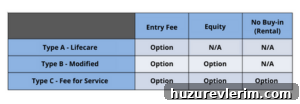
The chart illustrates six possible pairings of buy-in and monthly payment options. Note that rental buy-in models typically align with fee-for-service monthly billing. Also, independent-living monthly fees at rental communities are often higher than those at entry-fee communities when other factors are comparable.
When evaluating CCRCs, request detailed contract samples, compare scenarios for future care needs, and factor in location and amenities. That approach will give you a clearer picture of both short-term costs and long-term value.