

In several recent blog posts we explored common fears around moving to a retirement community, including the fear of the unknown in senior living decisions. At the heart of many of these worries is a widespread fear of losing independence as we age.
Most retirees express a strong desire to remain in their own homes and to keep their independence for as long as possible. To respond to those concerns effectively, it helps to clarify what “losing independence” actually means to older adults.
Americans’ preference for independence
The Associated Press–NORC Center for Public Affairs Research conducted a 2021 study to identify why people prefer to age at home. Using data from a representative NORC panel of U.S. adults, the study examined long-term care preferences and readiness. Key findings included:
- 88% would like to receive needed assistance or care in their own home or in a loved one’s home.
- Only 12% preferred care in a senior living community such as assisted living or a nursing home.
- 69% had done little or no planning to make aging at home feasible.
- Only 16% were confident they would have the financial resources to pay for long-term care, whether at home or in a facility.
>> Related: Aging at Home or in a Senior Living Community: The Freedom of Choice
Losing independence is a top aging concern
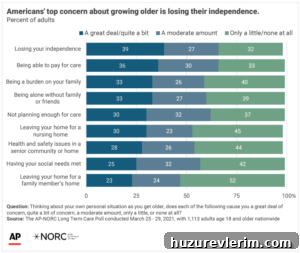
Image credit: AP-NORC
The AP-NORC study also asked respondents which issues worried them most about growing older. Respondents highlighted several top concerns:
- 36% were very concerned about the ability to pay for long-term care.
- 33% feared being a burden on family.
- 33% worried about aging alone without family or friends.
But the leading concern was losing independence: 66% said this concerned them, with 39% reporting a great deal of concern and 27% reporting a moderate amount. More than half (53%) also worried about having to leave their home to move to a care facility.
>> Related: Independence: A Double-Edged Sword?
Defining “losing independence”
“Losing independence” is a broad phrase that means different things to different people. For some, it simply means avoiding a move to assisted living or a nursing home. That view aligns with the strong preference to receive care at home.
For others, the fear centers on losing decision-making authority or daily autonomy—worries about being told when to eat, sleep, visit, or socialize. Many people assume retirement communities impose rigid schedules, which fuels anxiety about losing personal control.
Still others define loss of independence as being unable to remain safely in their own home due to health events such as stroke, dementia, or age-related mobility decline (for example, difficulty navigating stairs).
>> Related: New Statistics Could Reshape the Meaning of Aging in Place
An ironic senior living concern
There is irony in how some definitions of lost independence play out. Many of the scenarios people fear are avoidable, yet avoiding planning can increase the risk of becoming dependent. For example, people who insist on staying in a home that is not suited to future care needs—homes with many stairs or no main-floor bedroom and bathroom—may be forced to move suddenly to a care facility after an illness or injury.
Similarly, those who worry about losing decision-making power but do not share their care preferences with family or physicians may face decisions made on their behalf. The AP-NORC study found that among adults 60 and older, fewer than half had discussed long-term care preferences with family or friends, and only 14% had shared wishes with doctors. Without advance conversations and documents, caregivers and clinicians may have to make choices without knowing the older adult’s true wishes.
>> Related: Have “The Talk” with Aging Parents Sooner Rather Than Later
Taking steps to avoid losing your independence
While fear of losing independence is natural, there are practical steps that help preserve autonomy. Most solutions involve open-minded consideration of senior living options and thoughtful planning.
Begin by clearly communicating your senior living and care preferences to loved ones and to your healthcare team, and keep advance directives up to date. Financial and logistical planning is also essential. Practical actions include:
- Making home modifications to improve accessibility and safety.
- Discussing with family members who could assist if care is needed.
- Reviewing savings and resources to determine whether in-home care is affordable.
- Evaluating whether long-term care insurance would be worthwhile.
- Developing a relationship with a local care manager or care coordination agency that can step in quickly if needs change.
>> Related: For Senior Living Decisions, Are You a Planner, Procrastinator, or Crasher?
Considering your current living situation
A key step to preserving independence is an objective assessment of your current home. Emotion can cloud judgement, but honest evaluation helps determine whether the home will meet long-term needs. Consider:
- Are there few or no stairs, and is there a first-floor bedroom and bathroom?
- Are hallways and doorways wide enough for mobility aids like wheelchairs?
- Is the home located near transportation, shopping, and healthcare if driving becomes difficult?
- Are friends, family, social activities, and entertainment nearby to prevent isolation?
If your home satisfies these practical needs and you have access to caregivers when required, staying at home can preserve independence. If not, a move—either to a more suitable home or to a retirement community—may better protect your long-term autonomy.
>> Related: Aging in Place: 8 Questions to Consider
The retirement community option
Retirement communities, including life plan communities (also called continuing care retirement communities or CCRCs) and independent living 55+ communities, are designed to help residents remain independent longer. Their floor plans, services, and amenities focus on safety, health, and social connection.
If care needs progress beyond what independent living can safely provide, residents in many communities can transition to assisted living or skilled nursing—sometimes within the same campus. For those who want to avoid multiple moves and ensure ready access to escalating levels of care, a life plan community can offer security and continuity.
>> Related: Comfort, Convenience, Connection: The Key Benefits of a Retirement Community
A proactive approach to avoid losing independence
Worry about losing independence is understandable, but taking proactive steps—researching options, communicating wishes, making home and financial plans, and objectively evaluating living arrangements—can greatly increase the chances of maintaining autonomy. Whether you choose to stay in your current home, move to a different house, or join a retirement community, planning now helps you preserve independence and peace of mind as you age.